
Kristen Loken/Cal Performances
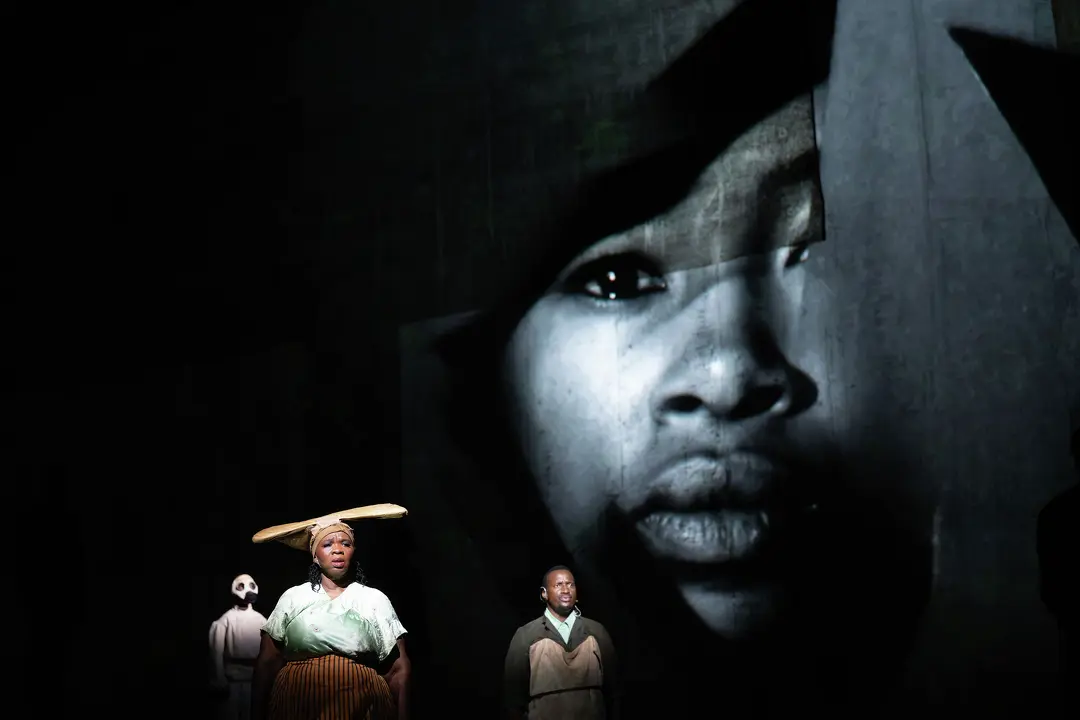
William Kentridge’s “The Head & the Load” is very, very big.
That might sound like a simplistic observation to make about an exquisite, allusion-rich, worlds-containing theatrical collage whose subject is the undercredited 2 million Africans who served in World War I. But the South African artist’s work, whose Cal Performances presentation opened Thursday, Nov. 12, with a limited run through Sunday, Nov. 15, has a scope broad enough to activate your fight-or-flight response.
“The Head & the Load”: Created and directed by William Kentridge. Through Sunday, Nov. 15. One hour, 45 minutes. $50-$175, subject to change. Henry J. Kaiser Center for the Arts, 10 10th St., Oakland. 510-642-9988. https://calperformances.org
Kentridge’s fusion of opera, shadow play, video, dance, performance art and more is staged not in Cal Performances’ customary Zellerbach Hall but in Oakland’s Henry J. Kaiser Center for the Arts, which can accommodate the production’s 180-feet-wide stage and 39 performers. That’s wide enough that no matter where you sit, your eyes can’t take it all in at once. Ping-pong your gaze from one side to the other, or from a human performer onstage to her giant silhouette interacting with the projection screen behind her, and some other stimulus flickers in your peripheral vision.
The effect is like sleight of hand. When did that oversized trunk open to reveal a box set and a small orchestra inside, and when did that whole line of chanters file onstage? Where and what is that otherworldly sound coming from, and when did the giant shadow puppets start looking maimed and mutilated?
Kristen Loken/Cal Performances
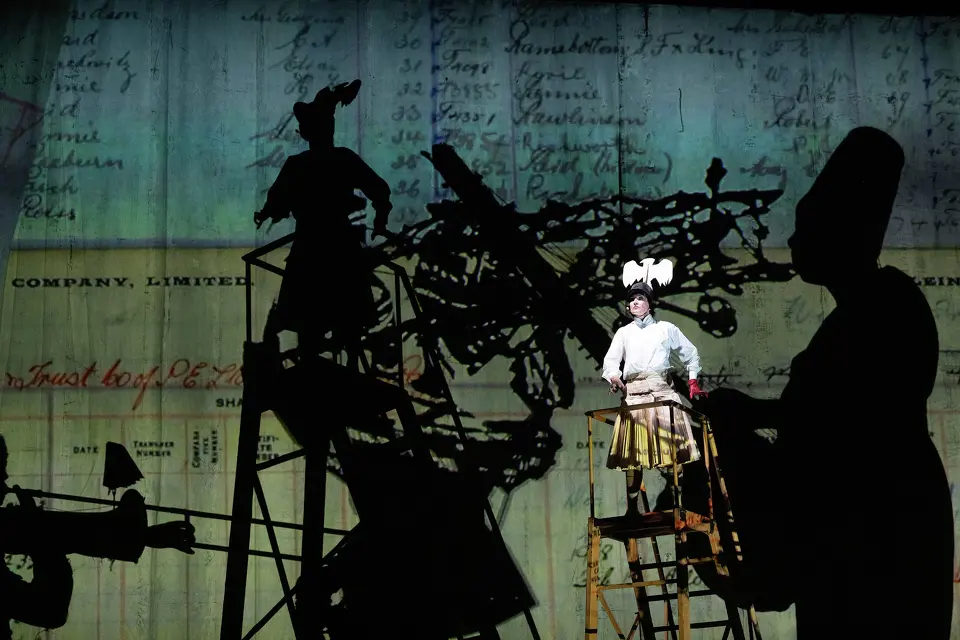
That long, slow parade of shadow puppets from one side of the stage to the other is one of the most affecting sequences in the show, which isn’t motivated by plot or character but by the juxtaposition of expressionist tableaux. In this scene, shadow puppets — artillery, planes, gas masks, human faces — are hoisted above each marcher’s head, then magnified by the lights and projection screen. Many African conscripts in the war carried supplies, and here the trudgers’ loads look huge, the way an ant might carry a burden many times its size. Underscored by an eerie soprano and a whole chorus of singers, it’s a march of ceaseless, overwhelming death.
It’s also the kind of art that does the impossible: It makes you feel a distant war’s toll.
In another especially vivid but more scaled-down sequence, two performers try to make their way across the stage, but one keeps falling, only for the other to prop him up and force him to salute. It’s like life is evaporating out of the body in each collapse, only for a mini-shock to jolt him back from the peace of the afterlife.
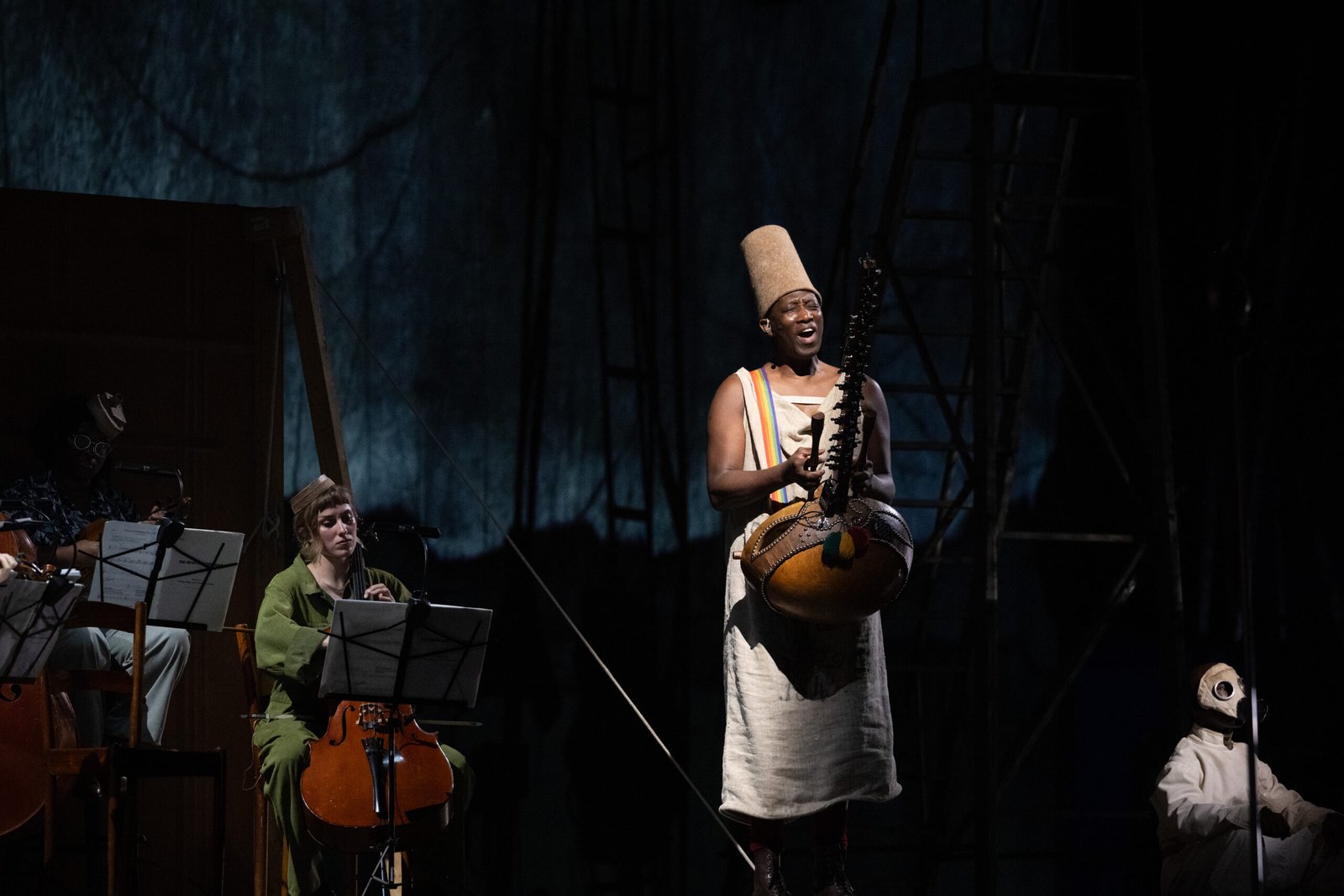
Finally, the two devise a new mode of transport. The weaker man lies almost flat on the floor but bends his knees, while the other man bends down to carry the back of his companion’s head. As they walk, to syncopated pizzicato from kora, cello and other string instruments, they resemble a farmer and a plow, a man made into a tool.
Kristen Loken/Cal Performances
The overarching feeling of “The Head & the Load” is of being plucked from the everyday world and submerged into a vast ocean of theater where time, pulse and breath slow down. It’s a state of refreshing, anything-goes contemplation periodically jarred by hair-raising choices. One guttural voice sounds like a cow pre-moo, then scales up into a siren’s blare. Everyone onstage eventually joins in to create an aural state of emergency.
At another point, a gorgeous soprano embarks on “God Save the Queen,” with a throaty alto, a creamy mezzo and more singers joining her in fugue.
But then they record-scratch the lyrics. One singer flutters back and forth on the words “God” and “save” like a songbird. Another enunciates the “k” in “king” as if he could hurt somebody with it. The British national anthem has been shattered, and the singers are using the pieces as weapons.
Such is the power of art, “The Head & the Load” attests. “They are not soldiers,” goes one line, speaking from the Europeans’ point of view; the African men’s names weren’t recorded, and they were given no registration numbers. But in Kentridge’s mammoth team, they have an army fighting for them now.
Source : San Francisco Chronicle
By Lily Janiak,Theater Critic


 Français
 English (UK)
 Nederlands (België)
 Deutsch